
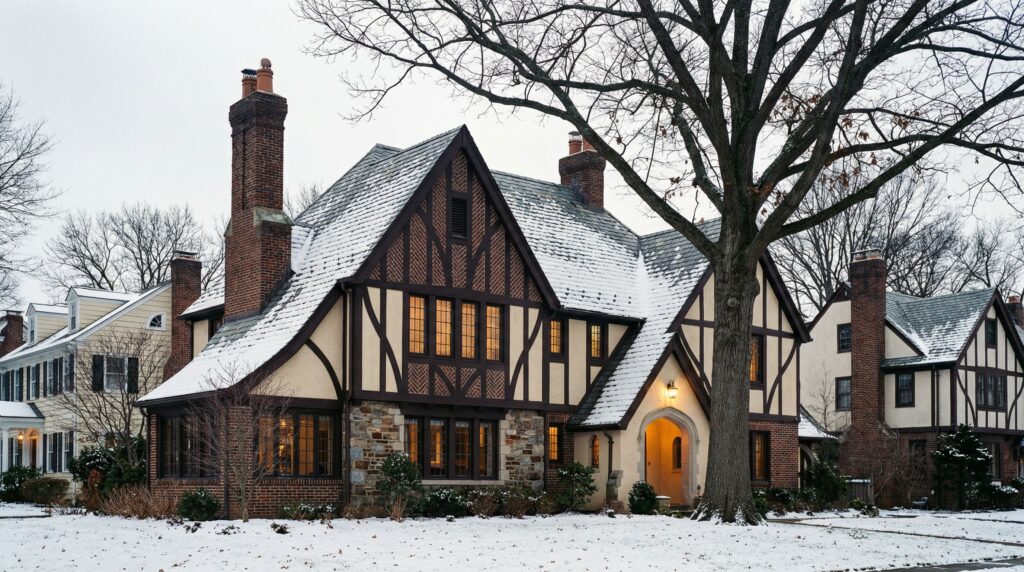
The 2025 Tudor market in Northern New Jersey delivered a remarkable year of momentum, characterized by strong buyer demand, significant appreciation across most towns, and a competitive landscape that favored positioned sellers. After a cooling period in 2024, the market rebounded with renewed energy, driven by economic stabilization, favorable mortgage rate dynamics, and an intensifying recognition that authentic Tudor homes represent an irreplaceable investment.
This comprehensive market analysis examines sales data, pricing trends, and competitive dynamics across the region’s most active Tudor markets. Whether you’re a seller evaluating your position or a buyer contemplating entry into this distinguished market, the data below tells a clear story: 2025 was a seller’s year, but strategic buyer positioning remains possible.
Executive Summary
The regional market processed 157 Tudor-style home transactions across Essex, Union, and Bergen counties in 2025, with notable variation by geography. The average sale price reached $1.13M, a significant data point when considering the diversity of home sizes, conditions, and location premiums. Homes spent an average of 26 days on market before closing, a metric that masks deeper competitive dynamics in premium neighborhoods. Across the region, appreciation averaged 14% year-over-year, though this figure represents the aggregate—several towns substantially exceeded this benchmark.
Competitive tension defined the market: 18% of all transactions involved highest-and-best offers, indicating multiple simultaneous offers in the same price range. Cash transactions represented 9% of sales, a lower percentage than expected given economic messaging around cash buyers, suggesting that traditional financing remains the dominant acquisition pathway even in premium segments.
County-by-County Breakdown
Essex County: The Established Core
Essex County remained the volumetric heart of the Tudor market, processing the largest share of regional transactions. The county’s market characteristics reflect established demand, premium positioning, and significant service delivery infrastructure.
Average Days on Market: 18 days. This competitive metric reflects strong buyer engagement and positioned inventory.
Appreciation: 7% year-over-year, the most moderate in the region, reflecting both the maturity of these markets and the already-elevated price bases established in preceding years.
- Montclair: 16 sales, $2.36M average price, 12 days on market. Montclair’s executive Tudor inventory commanded premium valuations, driven by comprehensive school systems, architectural distinction, and proximity to cultural institutions. Homes in the Mountain Avenue and Highland Place corridors experienced the steepest appreciation.
- Maplewood: 13 sales, 12 days on market average. Maplewood’s Renaissance continued, with young families and downsizing executives competing aggressively for inventory. The town’s mixed-use downtown development, proximity to New York commute infrastructure, and authentic 1920s-1940s housing stock drove continued appreciation.
- South Orange: Secondary but active market. Inventory remains constrained; homes in desirable condition move within 15-18 days. Village Green proximity and excellent school performance continue to drive demand.
Union County: The Growth Story
Union County emerged as 2025’s growth narrative, with robust appreciation and increasing buyer migration from more saturated Essex County markets.
Appreciation: 19% year-over-year, the strongest in the region and reflective of a market recognizing value and scarcity simultaneously.
- Summit: 6 sales, $2.22M average price, 14 days on market. Summit’s estates and Tudor manor homes continued commanding premium valuations. The town’s reputation for architectural significance, combined with constrained inventory and strong school systems, positioned it as an alternative destination for buyers priced out of western Montclair.
- Westfield: 10 sales, 30.62% appreciation, $1.70M average price. Westfield’s 2025 performance was extraordinary: the market recognized the town as undervalued relative to comparable Essex County alternatives. Multiple sales closed 25-35% above initial list prices. The downtown revitalization, improved commute options, and exceptional stock of well-maintained Tudors created a confluence of favorable factors.
Bergen County: The Emerging Market
Bergen County’s Tudor market remained nascent relative to Essex and Union, but 2025 marked meaningful momentum expansion. Towns including Oradell, Teaneck, and Tenafly began registering increased buyer interest.
Appreciation: 17% year-over-year, driven primarily by limited inventory and significant buyer migration from saturated Essex County submarkets.
Appreciation Leaders
Certain towns substantially outpaced regional averages, driven by specific market dynamics, inventory constraints, and buyer recognition of value.
- Verona – 39% appreciation. Verona’s combination of village character, executive-quality Tudors, and significant inventory scarcity created extraordinary price momentum.
- Teaneck – 38% appreciation. Early-stage market recognition as an alternative to saturated Essex County submarkets drove aggressive buyer positioning.
- City of Orange – 35% appreciation. Significant gentrification activity and young-family buyer cohorts seeking authentic architecture at lower entry points.
- Westfield – 31% appreciation. Strong fundamentals, scarcity, and buyer recognition of comparative value.
- Berkeley Heights – 29% appreciation. Larger-lot Tudors and estate properties attracted downsizing executives seeking space and authenticity.
Competitive Dynamics: The 18% Phenomenon
The most consequential market story of 2025 emerged from competitive intensity: 18% of all transactions involved highest-and-best (HAB) offer situations, meaning multiple simultaneous offers at the same price point competing for the same home. This metric demands attention from both buyers and sellers.
For sellers, HAB situations represented the highest-leverage opportunity: homes listed at appropriate price points in desirable condition moved quickly and attracted multiple buyers capable of competing on terms, timing, and contingencies. Towns where HAB situations were most prevalent included Montclair, Maplewood, Cranford, Glen Ridge, and Cedar Grove—all traditional strongholds with limited annual inventory turnover.
Competitive intensity in these markets meant closings 20-30% above list price. For sellers in these geographies, the strategic imperative centered on accurate positioning: underpriced inventory in premium condition triggered bidding wars; overpriced inventory languished. The market rewarded precision.
Fast-Selling Towns: The Sub-12-Day Markets
Three towns emerged as the fastest-moving Tudor markets, with average days-on-market below 12 days: Cranford (8 days), Oradell (9 days), and Cedar Grove (11 days). These markets exhibited exceptional scarcity relative to demand, meaning homes in sellable condition moved with urgency.
For sellers in these geographies, the implication is straightforward: inventory quality matters less than speed to market. For buyers, these towns demanded rapid decision-making and immediate offer capability to successfully compete.
The Cash Buyer Anomaly
Cash transactions represented 9% of all sales, a notably lower percentage than market commentary might suggest. This metric reflects the financing accessibility of the Tudor buyer cohort: executives, downsizing professionals, and family buyers with substantial liquid capital—yet still utilizing traditional financing for rate arbitrage and capital optimization purposes.
Cash buyers who did enter the market concentrated in two segments: 1) large-lot properties requiring significant renovation, where cash procurement accelerated acquisition timelines; and 2) estates or significant properties where financing complexity favored direct capital deployment.
What This Means for Sellers
The 2025 data delivers a clear message: positioning matters. Sellers whose homes matched buyer expectations regarding condition, price, and location moved quickly into competitive situations. The market rewarded strategic pricing and immaculate presentation. Sellers in high-appreciation towns (Verona, Westfield, Teaneck) benefited from market recognition; sellers in mature Essex County markets succeeded through competitive positioning and buyer identification.
The 26-day average masks critical geographic variation: Essex County homes in desirable condition move in 12-18 days; emerging markets like Westfield and Verona show similar velocity despite broader market development. Homes priced above market support languish; homes priced below market support trigger bidding dynamics.
What This Means for Buyers
The buyer market in 2025 required decisive action, pre-qualification clarity, and rapid offer capacity. In high-demand submarkets (Montclair, Maplewood, Cranford, Summit), successful acquisition demanded immediate response to listed inventory, frequently within 24-48 hours of market introduction.
Strategic buyers recognized that secondary markets—Westfield, Verona, Teaneck, Berkeley Heights—offered comparable authenticity and quality at substantially lower entry points and with less competitive intensity. The 2025 buyer who prioritized location over mere property characteristics found exceptional opportunity in emerging markets experiencing appreciation momentum.
Methodology
Data compiled from MLS records, recorded transactions, and market surveys across Essex, Union, and Bergen counties for the calendar year 2025. Transaction data reflects completed closings; pending transactions excluded. Average prices calculated across all completed sales; no adjustment for individual property characteristics. Days-on-market calculated from MLS listing date to recorded closing date.