
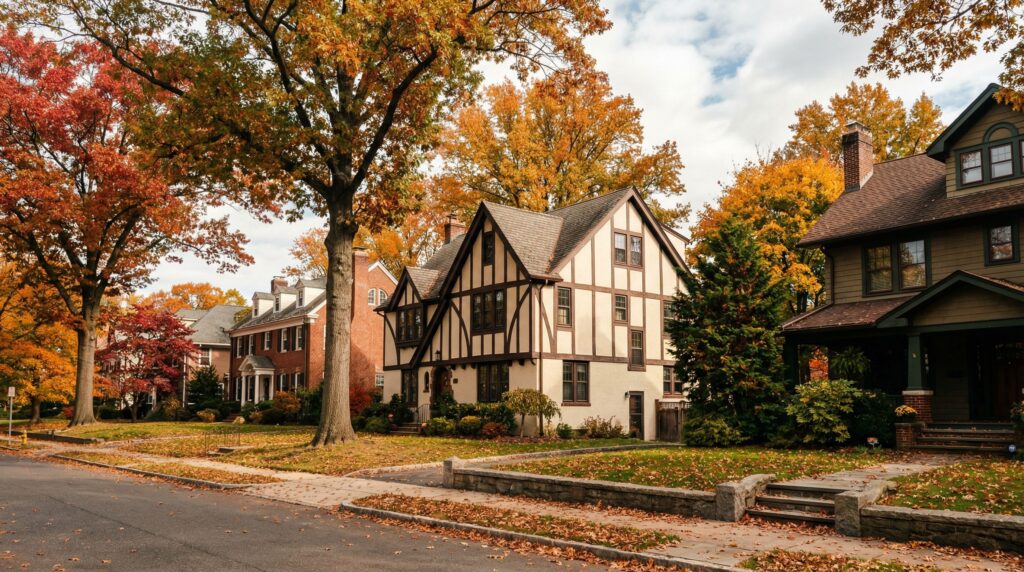
In 2025, Tudor homes across Northern New Jersey sold for an average of 111% of list price. Homes in Cedar Grove and Glen Ridge averaged 130%. Five individual sales closed at 150% or more of asking — with the highest recorded sale coming in at 163%.
Most agents present those numbers as a victory. I’d ask you to look at them differently. When a home sells at 130% or 163% of its list price, that’s not a triumph of marketing or the agent’s ability to sell — it’s evidence of underpricing. It means the home was positioned to the masses rather than positioned for the right buyer. It means the agent set a number low enough to get lots of foot traffic at an open house, generated heat, and let competing offers push the price up from an artificially low floor. The seller didn’t capture that gap — the market did.
Research from the Keller Center at Baylor University, drawing on a large national dataset, confirms this: selling above listing price does not necessarily mean the final sale price exceeds what accurate pricing would have achieved. The sale-to-list ratio is not a performance metric — it is a pricing disclosure.
Tudor homes are not mass-market homes. They attract a specific, passionate buyer: someone who has been looking for this architecture, who understands the craftsmanship, who will pay a premium because they’ve been waiting for exactly this. When you price and market to that buyer — with the right story, the right visuals, the right reach — you don’t need a bidding frenzy to get top dollar. You need the right person.
I’m Andrew. I specialize exclusively in Tudor-style homes in Northern New Jersey. What follows is the exact framework I use when representing Tudor sellers — an approach built not on generating volume, but on finding the one buyer who values what your home actually is.
| DATA SNAPSHOT • Tudor Homes, Northern New Jersey 2025 |
|---|
| Average sale price: $1,230,361 — up 11% from 2024 |
| Average sale-to-list ratio: 111% |
| Range: 88% to 163% of list price |
| 18% of sales required highest-and-best offers |
| Average days on market: 26 — Essex County averaged 18 |
| 18% of sales were all-cash transactions |
The Bidding War Fallacy: What the Numbers Don’t Tell You
The underpricing strategy — setting a list price below market value to generate competitive offers — is common in New Jersey real estate. Agents who use it will point to a 130% sale-to-list ratio as proof it works. But that number obscures more than it reveals.
First, the strategy is not reliable. Research from Realty Advocates found that even in a deliberately underpriced listing, there is roughly a 50/50 chance you will not receive a single offer above asking price. The approach requires a specific combination of rising prices, low inventory, and strong buyer demand. When those conditions aren’t present — as they weren’t in parts of New Jersey in 2025 — the seller has simply priced their home too low with no bidding war to compensate.
A study analyzing nearly 14 million home sales found that buyers who win competitive bidding situations systematically overpay and carry a higher risk of default. These are not the committed, financially secure buyers best suited to close with confidence on a Tudor transaction.
Second, bidding wars attract the wrong buyers. Competitive urgency draws buyers who are responding to price and competition — not to craftsmanship and character. When the excitement fades and the inspection period begins, those buyers are the most likely to ask for large concessions on an older home.
Third, and perhaps most importantly: research consistently shows that when a home is priced notably below market value, buyers’ first instinct is to wonder what’s wrong with it — not to celebrate the deal. For a Tudor home, where the entire value proposition is quality and original character, that association is damaging at the moment it matters most.
None of the standout sales in this market happened by accident. They happened because specific sellers made specific decisions — about pricing, about positioning, about photography, about the story they told and who they trusted to tell it. This guide is about those decisions.
Why Tudor Homes Are Not Like Other Listings
The standard real estate listing process was built for volume — for the efficient movement of interchangeable properties through a standardized system. Pull comps, set a price, photograph the rooms, write bullet points, upload to MLS.
That process is adequate for many homes, but not adequate for a Tudor.
A Tudor home is not interchangeable. The buyers who want it are not looking for just any property in a certain zip code and price range. They are looking for this specific type of home — the steep gables, the original glass, the craftsmanship, the character that cannot be built new. When you list a Tudor as if it were any other property, you fail to reach that buyer. And the buyer you’re left with is not the one who will pay what your home is worth.
Your home’s story is its most powerful sales tool — if you know how to tell it. Most agents don’t. And that gap costs sellers real money.
Step One: Price with Tudor-to-Tudor Intelligence
The most common pricing mistake in Tudor home sales is using generic comparable sales. A standard agent will pull everything that sold within a mile radius in the last six months and average it out. If your Tudor is surrounded by Colonials and Contemporaries, that approach produces a number that has nothing to do with what your home is worth to the buyer who is actually looking for it.
Tudor pricing requires Tudor comparables. That means looking at:
| PRICING COMPARABLES FRAMEWORK |
|---|
| Architectural Style Match Same architectural style — Tudor to Tudor, ideally with similar vintage and size |
| Same or adjacent town market dynamics shift across town lines |
| Condition Adjustment original details in excellent condition command a premium; compromised details reduce it |
| Feature-Level Analysis presence or absence of original leaded glass, intact plaster, unmodified millwork, and working period fireplaces all affect value |
| DOM Context what were market conditions when comparable sales closed, and how does that compare to today |
There is also a market-condition dimension to pricing strategy. Underpricing to generate bidding activity only works when prices are trending upward, inventory is low, and buyer demand is high. When inventory rises or conditions soften, buyers approach listings with the expectation of getting a good deal and are less inclined to bid above an already-low asking price. Correct pricing from the outset removes that risk.
When I price a Tudor listing, I’m not looking at the Colonial that sold last month. I’m looking at what Montclair Tudors are commanding, what’s happening in Maplewood and Glen Ridge and South Orange, and what the specific features of this home add or subtract relative to those comparables. That discipline produces a price the right buyer recognizes as correct — and correct pricing is the foundation of everything that follows.
Step Two: Tell the Story
The listing description for a Tudor doesn’t start with “Welcome Home” followed by a feature list.
It is a story.
Your hand-carved stair newel post is not a ‘wood railing.’ Your original leaded glass windows are not ‘vintage windows.’ Your limestone fireplace surround is not a ‘decorative feature.’ Your herringbone hardwood floor is not ‘hardwood throughout.’
Each of those phrases — the ones in quotes — are real examples from real Tudor listings. They are also exactly how you lose the buyer who would have paid $200,000 above asking.
The buyer who will pay a premium for a Tudor home is a buyer who understands what they’re buying. They know the difference between original leaded glass and a reproduction. They know what hand-laid masonry looks like. They have been searching specifically for a home like yours, and when they find a listing that speaks their language — that articulates the craftsmanship, the materials, the history — they respond with conviction.
The narrative has to run through the entire marketing package: the listing description, the photography, the video walk-through, the feature sheet, and the way your agent presents the home to other agents and their clients. Every touchpoint is an opportunity to tell the story — or to lose the buyer who needed to hear it.
Step Three: The Photography Standard
Tudor homes are extraordinarily photogenic when photographed correctly. They are photographed incorrectly in most listings.
Wide-angle room shots do not sell Tudors. What sells Tudors is detail: the leaded glass catching afternoon light. The hand-laid herringbone floor in the morning sun. The timber framing against the stucco exterior. The carved detail on the fireplace surround. The arched entry that frames a glimpse of the garden beyond.
These are the images that stop a buyer scrolling. These are the images that convert a browser into a showing request. A listing photography session for a Tudor should budget time specifically for architectural detail shots — not just the six standard room photographs that a general photographer would produce.
Video, when done well, adds another layer. A walk-through video that moves through the entry arch, lingers on the leaded glass, pauses at the fireplace, and captures the proportions of the principal rooms gives buyers the spatial and emotional context that still photography alone cannot. The buyer who watched that video before the showing has already begun to fall in love with the home.
Step Four: Control the Buyer Pool
The right buyer for your Tudor is not everyone who can qualify for the mortgage. It is the buyer who understands what they are acquiring — who values original character, who sees the craftsmanship as a premium rather than a maintenance concern, and who will pay accordingly.
A narrative-driven listing, properly photographed and distributed through channels that Tudor buyers actually use, filters the audience. It attracts buyers who respond to craftsmanship and character. It reduces foot traffic from buyers who will tour the home, enjoy the architecture, and then offer $50,000 below asking because they’re comparing it to the contemporary down the street.
Less foot traffic from the wrong buyers. More serious offers from the right ones. That is the goal — and it is achieved through positioning, not through a lower list price.
Step Five: Protect Your Value at Inspection and Negotiation
This is where many well-positioned Tudor sales fall apart — not because of the market, but because the seller’s representation couldn’t defend what was actually there.
Old homes get flagged by inspectors. That is simply true. A Tudor will have a slate roof, original windows, plaster walls, older mechanical systems, and a construction vocabulary that a general home inspector may not be fully equipped to evaluate. When an inspector flags these elements without context, buyers can panic — and panicked buyers ask for large concessions.
The agent who represents you at this stage needs to know the difference between a slate roof that has 40 years of life remaining and one that needs replacement. They need to be able to explain, with specificity, why a steam radiator system is an asset rather than a liability. They need to contextualize plaster wall cracks as cosmetic rather than structural when that’s what the evidence shows. They need to know what a building permit history does and does not tell you about renovation quality.
When your agent can do all of that, the inspection contingency period is a manageable process rather than a negotiating ambush. When they can’t, you end up conceding value that should have been protected.
Pre-Sale Decisions: What to Fix, What to Leave Alone
Before you list, the question of what to address is among the most consequential decisions you’ll make. The wrong answer costs you either in sale price or in unnecessary renovation expense.
The framework I use with seller clients is straightforward: address anything that affects buyer confidence without compromising original character. Do not renovate anything that a Tudor buyer will value in its original state.
DO:
- Repair the slate roof if spot repairs are needed — this removes a major negotiating point
- Address any active water infiltration at windows, stucco, or the foundation — these are real problems
- Service the boiler and have the records available — a serviced, documented boiler is an asset
- Refinish original hardwood floors if they are worn — this is preservation, not renovation
- Paint the interior and exterior if needed, using period-appropriate colors
- Close all open permits with the town
DO NOT:
- Replace original windows with modern substitutes
- Open up floor plans or remove architectural partitions
- Install modern kitchen or bathroom finishes that clash with period character
- Replace plaster with drywall
- Paint over original millwork if it can be preserved
The Timeline: What to Expect
With proper preparation, a Tudor listing in a strong market should move within the average 26-day window — and in the fastest markets, considerably sooner. Montclair averaged 12 days on market in 2025. Maplewood averaged 12. Cedar Grove averaged 11.
The preparation timeline I recommend for sellers looking to list in 30 to 60 days:
| RECOMMENDED PREPARATION TIMELINE | |
|---|---|
| Week 1 | Market analysis and pricing strategy — Tudor-to-Tudor comparables, condition assessment, pricing recommendation |
| Week 2 | Pre-listing punch list — identify and address any items that affect buyer confidence |
| Week 3 | Photography and video production — schedule at the optimal time of day for the home’s light |
| Week 4 | Listing copy finalized, MLS preparation, and agent network preview |
| Week 5 | Active listing — with a showing strategy designed for the level of competition expected in the market |
The market is telling a clear story. In 2025, the towns seeing 28–39% year-over-year appreciation are not random fluctuations. They are buyers discovering what Tudor homes are actually worth — and paying for it correctly. Sellers who position correctly capture that value. Those who don’t leave it on the table.