
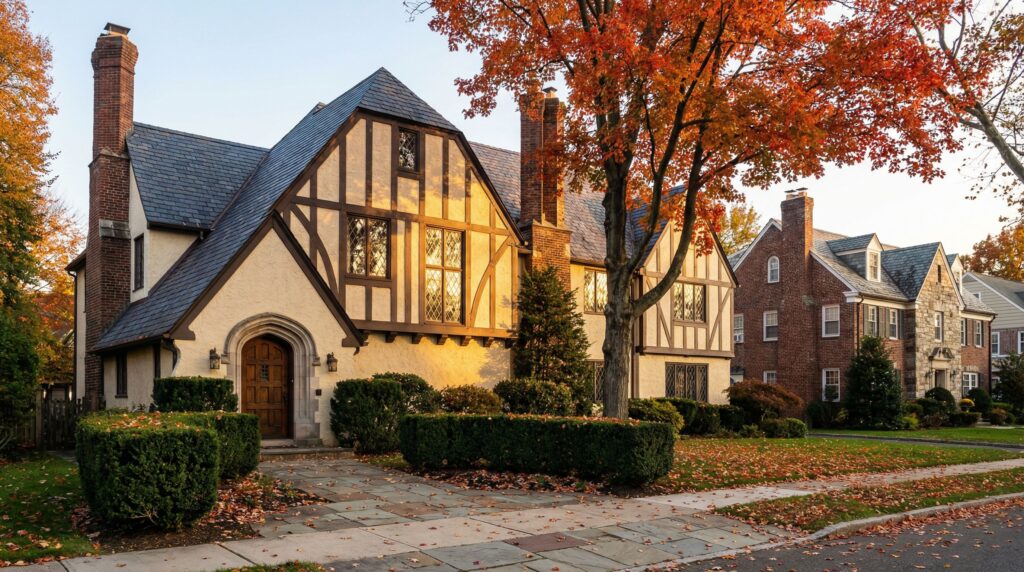
The data doesn’t lie — and neither does the craftsmanship
In Northern New Jersey’s Tudor home market, that story is one of quiet, consistent dominance — the kind that doesn’t make headlines but absolutely shows up in your net worth.
Let me give you the numbers straight. In 2025, Tudor-style homes across Essex, Union, and Bergen Counties sold at an average of $1,230,000 — an 11% increase over 2024, and a 20% increase since 2022. For the first time, the median Tudor sale price crossed $1 million, landing at $1,065,000. In a broader real estate environment where many segments stalled, Tudor homes didn’t just hold. They climbed. And when you drill into specific towns — Montclair averaging $2,363,800, Summit at $2,216,700, and Millburn at $1,996,300 — you start to understand what I mean when I say this segment is in a class of its own.
Real estate trends come and go. I’ve watched neighborhoods transform overnight, watched properties that seemed like sure bets languish, and watched “overlooked” homes become generational wealth. Tudor homes have consistently outperformed the noise — not because of hype, but because of what they fundamentally are.
Character counts. Period.
Steep gabled rooflines, hand-laid brick and stonework, original leaded glass, timber framing, intricate millwork — these aren’t decorative afterthoughts. They are structural and architectural commitments made by craftsmen who knew their work would outlast them. And it has. Many of the Tudor homes in Northern NJ were built in the 1920s and 1930s and are in better architectural condition than tract homes built fifty years later.
But investment value isn’t just about bones. It’s about demand. And the demand signal for Tudors in Northern NJ is exceptionally strong. In 2025, nearly 70% of Tudor sales closed above original list price. The average days on market was just 26 days, with the fastest towns — Maplewood, Summit, and Millburn — averaging under 16 days. In Cedar Grove and Glen Ridge, buyers were paying an average of approximately 130% of list price — a figure that speaks to just how fiercely buyers compete for these homes when they come to market.
And for buyers? The appreciation story is still unfolding in several towns. Cranford saw a 56% jump in average Tudor sale prices from 2024 to 2025. Verona was up 39%. Westfield rose 31%. These aren’t random fluctuations — they’re a pattern. Towns adjacent to already-premium markets are being discovered by buyers who want architectural character without the Montclair price tag. That window is open, but it won’t stay open forever.
A Four-Year Track Record Worth Knowing
The data now covers four full years of Tudor sales across Essex, Union, and Bergen Counties, and the trend line is unmistakable. From 2022 through 2025, the average Tudor sale price rose from $1,023,000 to $1,230,000 — a 20% gain. The median price climbed from $850,000 to $1,065,000, a 25% increase. These are not appreciation figures for a single hot year. This is a consistent, multi-year story of a segment that keeps delivering.
The Uncomfortable Truth
The numbers above tell a compelling story — but they also reveal an uncomfortable truth. When nearly 70% of Tudor homes are selling above original list price, it means buyers are willing to pay more. The question sellers should be asking is: how much more are they leaving behind? Most agents approach unique, character-driven homes the same way they approach every other listing — broad syndication, generic photography, and a price calibrated to attract the widest possible pool of buyers. That strategy optimizes for speed, not value. A Tudor home marketed to the masses will find a buyer. But the buyer who would have paid a true premium — the one who has spent years looking specifically for original leaded glass, for that particular roofline, for a home that simply cannot be replicated — may never have seen it. They weren’t in the mass pool. They were waiting for someone to find them. That’s the gap between what most Tudor sellers receive and what their home was actually worth. And in a market where the spread between list price and sale price is already this wide, closing that gap is where the real money lives.
The Bottom Line
Whether you’re buying or selling, the single most important decision you make isn’t which home to choose or what price to list at. It’s who you trust to guide you through the process.
The market is telling a clear story. Are you listening to it?
*Statistics based on MLS sales data for Tudor-style homes in Essex, Union, and Bergen Counties, 2022–2025.